A quick guide to the documents that were on exhibition
Draft Delivery Program and Operational Plan
The draft Delivery Program and Operational Plan (DPOP) outlines a significant program of projects and service delivery that has been developed in response to the Community Strategic Plan 2025-2050 (CSP). Council's four-year Delivery Program was initially adopted in June 2025, including a Year 1 Operational Plan for 2025/26. The four-year Program has now been updated for Year 2 including an Operational Plan for 2026/27.
The CSP 2025-2050 was also endorsed by Council in June 2025 and is driven by five strategic pillars representing the high-level directions for our City over the next 25 years:
.png)
Council reviews the DPOP and Resourcing Strategy every year to ensure the programs and projects are on track and continue to support the outcomes of the CSP.
The draft Year 2 Delivery Program is a four-year plan, and includes a draft Operational Plan for the 2026/27 financial year, which outlines the specific services, projects, performance indicators, and draft Budget details for the period.
Key project highlights in the draft DPOP 2026/27:
- Arts and cultural projects to support our creative and diverse communities such as the continuation of Riverside Theatres redevelopment, an upgrade to Epping Community Centre (School of Arts), the updated Heritage Review program and development of the Parramatta Cultural Hub and Harris Park Cultural Precinct.
- A capital works program that includes upgrades to a range of Council’s parks, sportsfields and community hubs while delivering an increased number of active transport links and an updated Community Infrastructure Strategy to support accessibility, social wellbeing and community connection.
- The development of key strategies and plans that help support our vision of becoming a prosperous and productive city such as the Visitor Economy and Night Time Economy Plans, the Special Entertainment Precinct plan and the city’s Retail Strategy.
- Projects that help nurture our local environment and build a resilient city such as the delivery of a Tree Action Plan, the remainder of the Duck River Nature Trail, the Stormwater Harvesting and Reuse Program and updating our Nature Positive Plan.
- A number of innovative and future-focused initiatives and large-scales infrastructure projects to help transform the city such as the construction of Civic Link – Block 3, the Eastern & Western Parramatta River and CBD Precinct connections, and planning for the Harris Park & Rosehill precinct.
The draft Year 2 Delivery Program, Operational Plan and Budget ('DPOP') and summary versions are available in the Resources section of this page.
Draft Budget 2026/27
Council has budgeted for more than $570 million in operating and capital expenditure in the 2026/27 financial year. This will fund the broad range of services and projects listed in the DPOP and includes a strong program of capital works for the year.
For 2026/27, Council is budgeting an operating revenue of $385.9 million, excluding:
- $103.8 million in capital grants and contributions, and
- $0.7 million in net gains from the disposal of assets.
Of this, operating revenue, $257.8 million is expected to be generated from rates and annual charges.
Operating expenses are budgeted at $393.6 million, resulting in a net operating deficit of $7.71 million, before capital grants and contributions and asset disposal gains or losses.
This deficit does not affect Council’s cash or service delivery - it mainly reflects standard accounting requirements, such as depreciation, rather than real‑world spending pressures. Council is in a strong financial position with the budget showing a cash surplus of $71.7 million, demonstrating that City of Parramatta continues to have the financial capacity to fund and provide essential services and progress major infrastructure projects.
For every $100 spent this year, Council will deliver:
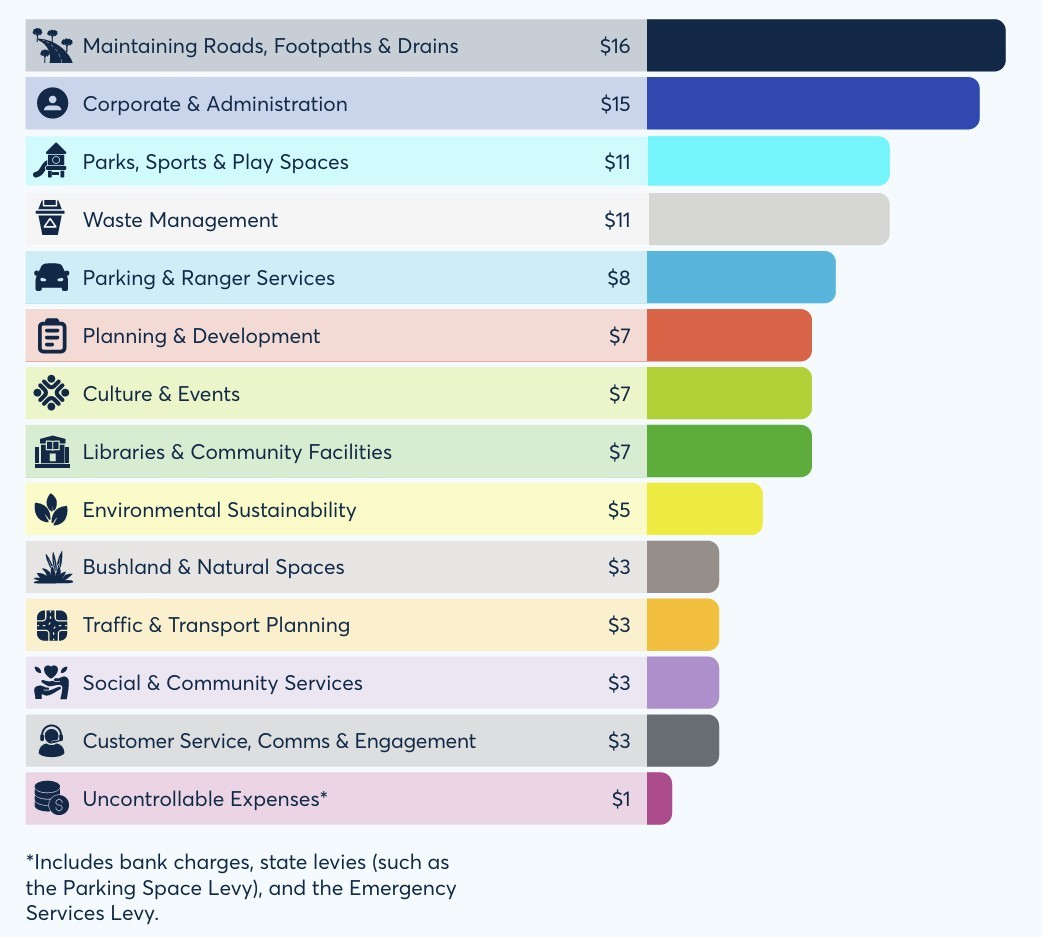
You can find more details about our draft Budget 2026/27 in the Resources section of this page.
Rating Structures
The draft Budget includes proposed rating structures for 2026/27 for all rateable properties (residential and business). Rates and charges are Council’s main source of recurrent income, and are used to maintain infrastructure and deliver services and facilities to the community.
Council typically increases its rates by a small amount each year, to cover increasing costs of delivery. Limits to annual rate increases are determined by the Independent Pricing and Regulatory Tribunal (IPART) – known as the 'rate peg' – setting the maximum general income Council can collect from ordinary rates.
The draft Budget 2026/27 includes the application of the full IPART approved rate peg of 4.8%.
You can read more about the draft Budget including proposed rating schedules in the Resources section of this page.
Draft Fees and Charges 2026/27
Council's draft Fees and Charges 2026/27 outlines a range of updated fees and charges proposed for Council services. These are scheduled to commence on 1 July 2026.
Similar to rates, Council's fees and charges are typically increased by a small amount each year, to keep up with inflation and increasing costs of service delivery. The draft Fees & Charges 2026/27 include the application of a general 5% increase to unregulated fees and charges.
The proposed fees, including key changes (new fees, discontinued fees and increases more than 5%), can be found in the Resources section of this page.
Draft Resourcing Strategy plans
To implement our strategic and operational plans, Council needs to carefully manage finances, assets and infrastructure, and the workforce. To do this, Council prepares and regularly reviews a suite of long-term supporting plans known as the Resourcing Strategy.
To support the review of the DPOP this year, Council has reviewed and updated the below Resourcing Strategy plans. A Resourcing Strategy Summary can also be found in the Resources section of this page.
Draft Long-Term Financial Plan
The Long-Term Financial Plan is a 10-year rolling plan that informs decision-making and demonstrates how the objectives of the City’s CSP and commitments in the DPOP will be resourced and funded. It helps ensure that Council can continue delivering its broad range of services and projects in a financially sustainable way.
Draft Asset Management Strategy and Plans
Council’s Asset Management Strategy outlines plans and strategies that help ensure all assets under Council’s control are maintained and managed in a responsible and cost-effective manner.
Council has prepared an Asset Management Plan Infrastructure Portfolio for its Buildings, Parks and Open Spaces, Stormwater Network and Road Infrastructure assets. This plan has been developed to respond to community needs and expectations around acceptable levels of service, asset conditions, and long-term asset sustainability.
Draft Workforce Management Strategy
The Workforce Management Strategy details priorities and actions to be implemented during the next four years, to ensure Council has a workforce capable of delivering all outcomes, services and initiatives identified in the CSP and DPOP.