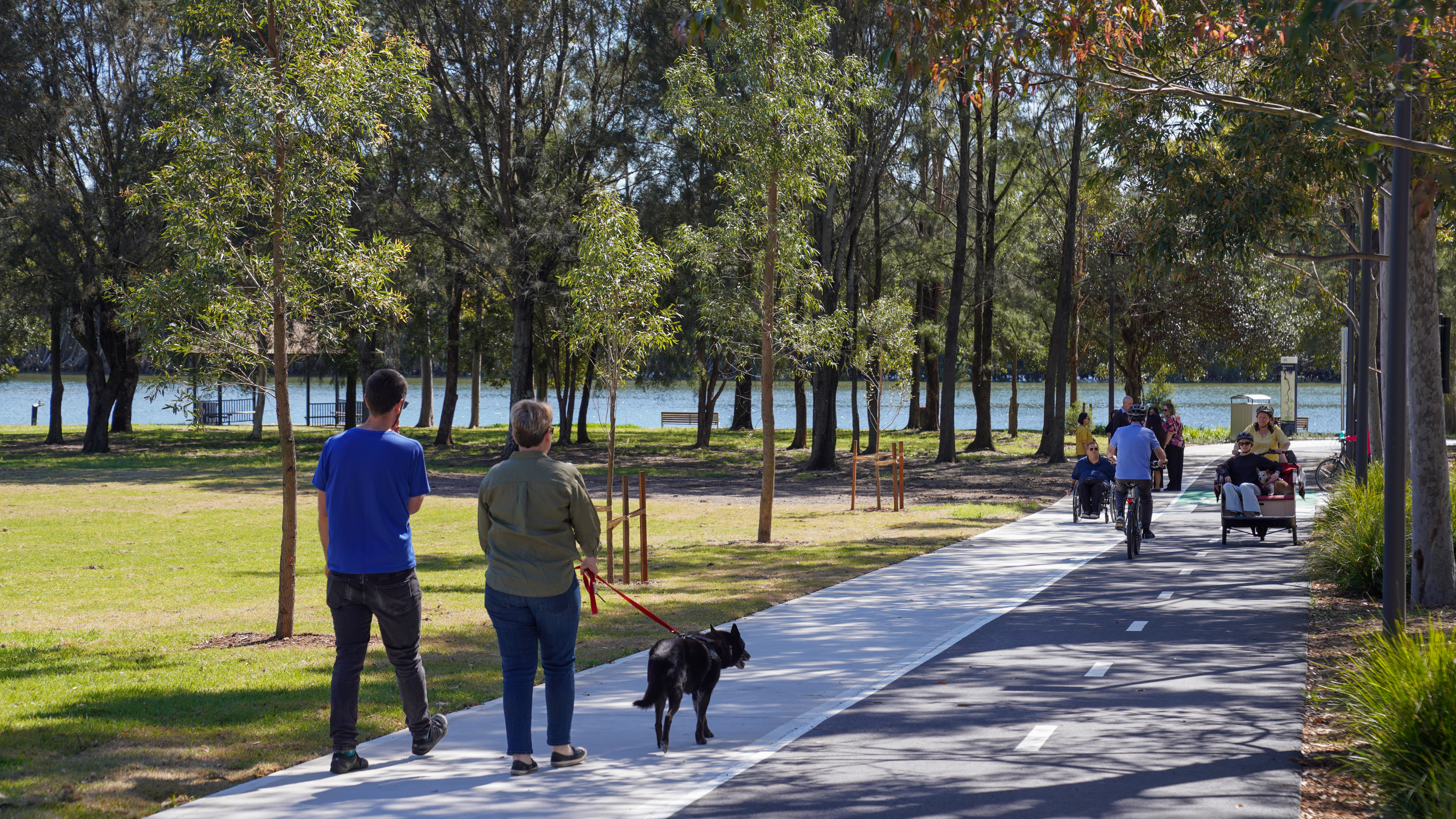
While the Parramatta Valley Cycleway (PVC) has been delivered over 35 years in stages since 1991, patronage has grown exponentially in the last five to six years with the completion of some of the final stages. This is largely due to the safety of being completely off-road.
Our community embraces active transport and benefits from improved physical and mental health outcomes when provided with safe opportunities to walk in nature and to ride along separated paths. The accelerated delivery of Duck River Nature Trail offers the opportunity to promptly deliver the 4.5kms of links in less than four years to ensure the benefits to the community of a completely separated walking and cycling facility are immediately realised. Employees within Silverwater and Camellia, along with future residents of a re-developed Camellia, will be provided with alternative healthy, enjoyable and direct connections to their place of employment and neighbourhood facilities.
The project will also draw-in walking groups and cyclists from a wide catchment for personal recreation and transport trips. The Duck River Nature Trail will contribute to a more accessible, healthy and connected community that will have a greater visibility and awareness of the environment. With a minimum design life of 50 years, the benefits will be enjoyed by the generations to come.
To be delivered in three stages from mid-2025 to 2028 this project looks to unlock previously inaccessible foreshore land allowing residents and visitors to enjoy 4.5km of off-road walking and cycling while taking in scenic river views.
In Silverwater Park (Stage One), the existing 2.5m wide shared path will be replaced with a 4.5m wide path, with line-marking to provide separate space for pedestrians and riders. Lighting will also be provided along with bicycle parking, a water fountain and more bench seating. The 450m off-road path will provide more space for people to safely enjoy the park and connect from Wilson Park down to Clyde Street. The following stages of the project including the Eastern River Bank and Western River Bank will see the Duck River Nature Trail provide one of the few north-south walking and cycling routes in the Central River City that will be separate from traffic.
Eastern River Bank:
- 1km+ of separated bike paths and footpaths along the streets of Silverwater where the Duck River foreshore is inaccessible, with new street trees, lighting and raised priority crossings of all streets
- Almost 2km of boardwalk and concrete shared path along the river corridor and in Silverwater Park
Western River Bank:
- A 5m wide, 35m long pedestrian and cyclist bridge over Duck Creek
- Just under a kilometre of boardwalk and generous shared paths adjacent to the river corridor
The project will include lighting at all street crossings and the route adjacent to public streets will also be lit. Lighting along the northern Silverwater street alignment will be upgraded to meet current standards and short sections of the Duck River corridor that connect public streets (Giffard Street to Holker Street, Canarvon Street to Adderley Street West) will be lit as they are short connections with better passive surveillance.
An Environmental Impact Statement (EIS) and a Review of Environmental Factors (REF) are documents that are prepared to demonstrate due diligence and comply with the requirements of the Environmental Planning & Assessment Act (1979).
An REF typically applies to construction activities which do not require consent under the Act. Instead, the proponent (in this case, the City of Parramatta) must clearly demonstrate it has identified all environmental impacts of the proposal, along with mitigation measures to minimise those impacts. The REF needs to be appropriate to the nature and scale of the proposal, and often draws on specialist studies to reach a conclusion on the nature and extent of impacts and mitigations.
An independent planner was commissioned to prepare the REF for Silverwater Park. The planner integrated the advice and findings of all specialist designers and engineers who prepared the design for the upgrade and associated works. This was supplemented by reports commissioned for the project from heritage specialists, archaeologists and ecologists. The City of Parramatta is committed to implementing the mitigations and safeguards identified in the REF. The REF for Stage 1 Silverwater Park will be shared with the community shortly. An EIS is being commissioned for Stage 2 and Stage 3 of the project.
The vision for Duck River Nature Trail is to unlock the significant areas of high-value ecological communities that are currently hidden from view and allow the community to safely experience walking and cycling along the foreshore. The project will undergo rigorous planning processes including the preparation of an Environmental Impact Statement and for Silverwater Park a Review of Environmental Factors.
Prepared by specialists, these planning instruments mean that plant and animal species will be documented, any protection zones identified and clear construction methods specified to ensure minimal footprint and impact on the environment including fragile saltmarsh and mangrove areas. The overarching goal for the project is to improve the river landscape. Construction will comply with environmental performance measures to ensure the protection of land and water.
Early surveys and maps suggest the Duck River area downstream from the confluence with A'Becketts Creek was a wetland of saltmarsh, rushes and grasses. Upstream, there were Eucalypt forests. While there are now weed species throughout the site, one of the goals for the Duck River Nature Trail is to unlock the foreshore for public use and through sensitive environmental design create a riverscape that improves the landscape and the environmental performance of Duck River and its foreshore areas.
The wetland areas within Duck River are of regional conservation significance, providing home to three Endangered Ecological Communities and several threatened species. Native wildlife includes possums, many species of birds, frogs and reptiles such as the water skink. Budgerigars and brush turkeys have been recorded along with the Satin Bowerbird and Red-Browed Finch.
In addition to the mangrove vegetation that lines the riverbanks, wildflowers are common in late winter, and small orchids may be observed.
Designed with the smallest footprint possible and placed in locations which will tolerate disturbance, boardwalks and paths will offer the community safe access to the wetland areas of Duck River, unlocking new pedestrian and cycle paths for all to enjoy.
There are a number of birds and native animals that make Duck River and surrounds their home including:
- Grey Headed Flying Fox
- Eastern Dwarf Tree Frog
- Striped Marsh Frog
- Superb Fairy Wren
- Satin Bowerbird
- Brown Gerygone
- Red-Browed Finch
- Dusky Woodswallow
The Duck River Nature Trail project is co-funded by the NSW Government and Council. Funding is provided under the NSW Government’s Western Sydney Infrastructure Grants Program and the New South Wales Get Active NSW program.
The $2 billion Western Sydney Infrastructure Grants Program (formerly known as WestInvest) is funding transformational infrastructure projects across Western Sydney. Funded projects will improve the liveability of communities and support economic recovery, making a real difference to the quality of life in 15 Local Government Areas in the region.
For more information see https://www.nsw.gov.au/grants-and-funding/western-sydney-infrastructure-grants-program
The vision for the Duck River Nature Trail is to unlock the significant areas of high-value ecological communities that are currently hidden from view and allow the community to safely experience walking and cycling along the foreshore.
With an overarching goal to improve the river landscape, the project aims to use sensitive environmental design to create a riverscape that improves the landscape and the river’s environmental performance.
The project will undergo rigorous planning processes that mean plant and animal species will be documented and any protection zones identified. The planning process will also stipulate clear construction methods to ensure minimal footprint and low impact on the environment including fragile saltmarsh and mangrove areas.
Designed with the smallest footprint possible, and placed in locations which will tolerate disturbance, boardwalks and paths will offer the community safe access to the wetland areas of Duck River, unlocking new pedestrian and cycle paths for all to enjoy.
The wetland areas within Duck River are of regional conservation significance, providing home to three (3) Endangered Ecological Communities and several threatened species. Native wildlife includes possums, many species of birds, frogs and reptiles such as the water skink. Budgerigars and Brush Turkeys have been recorded along with the Satin Bowerbird and Red-Browed Finch.
In addition to the mangrove, saltmarsh and native grasses that line the riverbanks, wildflowers are common in late winter, and small orchids may be observed.
Early in the project, plant and animal species will be documented and any protection zones identified. The planning process will also stipulate clear construction methods to ensure minimal footprint and low impact on the environment including animal habitats and fragile saltmarsh and mangrove areas.
Duck River Nature Trail will open in stages:
- Stage One (Silverwater Park) opened to the public in October 2025
- Stage Two (Eastern Streets) is expected to open in mid-2026
- Stage Three (Eastern and Western River) is anticipated to open in 2028
Thank you to everyone who participated in providing feedback on concept designs for Stage 1 in August 2024. Stage 1 focused on Silverwater Park introducing separated paths for pedestrians and cyclists. Other improvements included: lighting; bicycle parking and a maintenance stand; a water fountain; tree planting and more bench seating.
Following public exhibition of the Stage 1 concept design in August 2024, the project was approved by Council in November 2024.
Following contributions from the community, the design was updated to reflect community feedback. Detail design and approvals were completed (for further information, see Stage 1 detailed design in the resources tab). Stage 1 is expected to begin construction in March 2025. The first stage of the Duck River Nature Trail is expected to open by September 2025.
Silverwater’s heavy industrial past means there are some interesting looking structures which lend a stark architectural backdrop to walks along the river. While there is still some industry present, saltmarshes and mangroves and the birds and animals that call the area home are key attractions that the community will be able to appreciate as boardwalks and cycle paths are built.
City of Parramatta will be working closely with environmental specialists to reduce weeds, improve drainage and have an overall positive impact on the environment. As with other areas along the river dense with vegetation, mosquitoes can be an issue. Council expects that from time to time it will take active measures to control larvae and mosquitoes. Park users will be advised to use repellent, wear long sleeves, and avoid being close to the marsh areas during times when there are more mosquitoes around, including dusk.
Yes, a total of eight (8) trees will be planted. We will use species endemic to the area, specifically suited to the existing Estuarine Swamp Oak Forest vegetation community.
In addition to wider (4.5m) line-marked and signed paths for cyclists and pedestrians, designed to offer safe clearance and enough space for path users to travel at their own pace, planned upgrades to Silverwater Park include a deluxe bicycle repair stand where cyclists can pump-up their tyres and use some basic tools for bike maintenance or repair. Tools include tyre levers, pedal wrench, wrenches and screw drivers. Path users will also find bike racks, drinking fountains, seating and bins.
A Review of Environmental Factors (REF) is a document which forms part of formal planning approvals.
The REF for the Duck River Nature Trail Stage 1 (Silverwater Park) assesses the potential environmental impacts which may be caused by the construction of the project. It considers work which includes the partial demolition of footpaths, construction of a 4.5m wide shared path and a 2.5m wide cycle path, and the proposed installation of lighting posts that are 5m high with lights located at 15m spaces.
Within the Duck River Stage 1 proposal, the removal of eight (8) trees has been identified, with 11 replacement trees, additional planting and landscaping.
The REF outlines mitigations that must be incorporated into the developed design and construction plans.
The minor nature of the proposed works to deliver Stage 1 of the Duck River Nature Trail, is unlikely to cause any significant adverse environmental impacts.
Users of Silverwater Park and adjoining sites, and workers, are also unlikely to be negatively affected by the works.
Some short-term minor impacts, including noise and vibration, are likely to be generated by the construction works. However, the overall community benefit from the proposed work is likely to significantly outweigh any short-term impact.
Council intends to ensure that works follow the Construction Management Plan (CMP) which will be prepared by the contractor. The plan will address the measures identified in the REF that mitigate or minimise environmental impacts. The CMP also details the protocols for communicating with relevant authorities, the community, and other stakeholders.
The full REF for Stage 1 of the Duck River Nature Trail project can be found in the Resources section on this page.
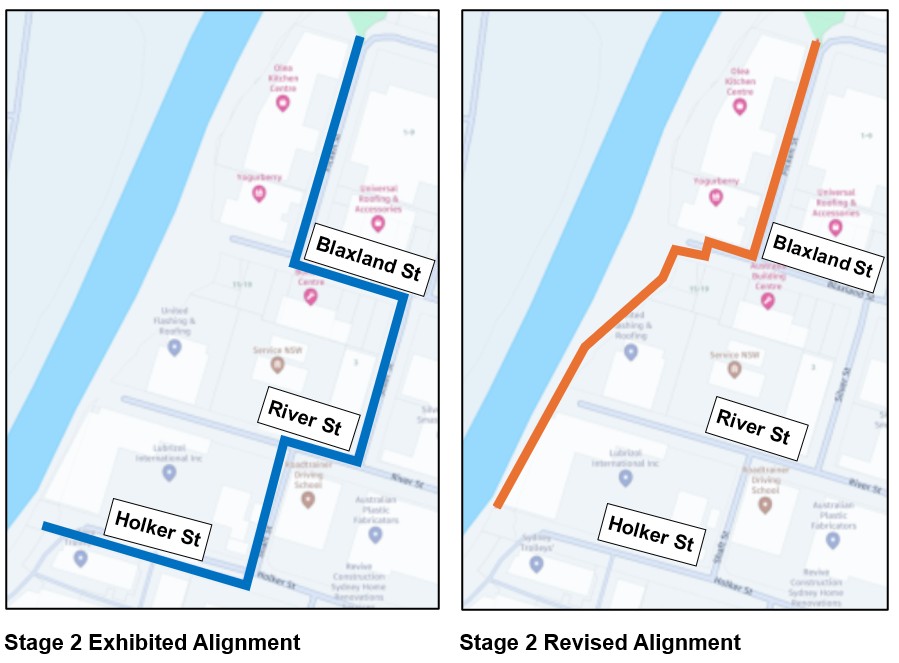
In February - March 2025, Council exhibited Stage 2 of the Duck River Nature Trail project. Overall community feedback strongly supported the proposal, but there were concerns about impacts to street parking and increased pedestrian and cyclist movements in an industrial precinct, as well as a desire for more of the alignment to be on the foreshore and the need to care for our natural spaces.
We’ve listened to community feedback and explored our options carefully. Following further investigation, Council is pleased to share that Stage 2, between Blaxland Street and Holker Street, has been re-aligned along Duck River foreshore.
See the endorsed Concept Design and Council Report in the Resources section for more information.
There are three streets where changes are proposed to accommodate the Duck River Nature Trail.
These changes are in areas where paths next to the Duck River are not possible: Blaxland Street; Picken Street and Junction Street. Raised crossings that give priority to pedestrians and cyclists will be constructed at Blaxland Street and Junction Street.
To keep streets as wide as possible (and to minimise changes to traffic conditions for large trucks, and potential interactions with pedestrians and cyclists), Council endorsed retaining Picken Street as two-way and replacing the parking on the western side with the bicycle path.
With the re-alignment, no changes to parking are proposed for Silver Street, Holker Street and River Street. The design for the crossing of Blaxland Street has been revised to retain parking on both sides and maintain access to existing driveways.
See the endorsed Concept Design and Council Report in the Resources section for more information.
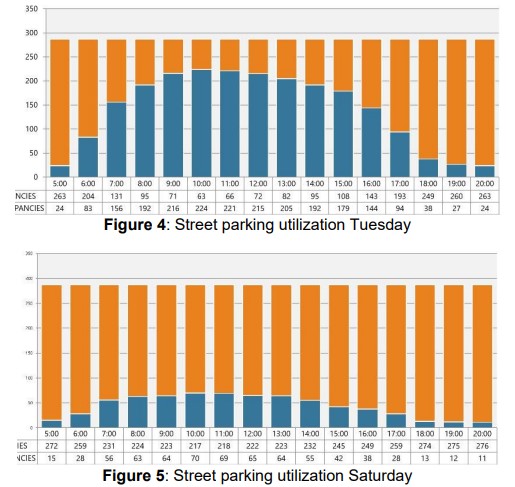
To assess the impact of this proposal, comprehensive hourly video parking surveys were completed on a weekday and weekend to understand demand. Peak usage of the 287 available spaces is 220 on a weekday and 70 on a Saturday midway through the morning, as per Figues 4 and 5 below (as per the Council Report 9 December 2024).
The Eastern River section of Stage 3 proposes just under two kilometres of new nature trail between Canarvon Street and Blaxland Street in Silverwater, with street connections at Derby Street, Giffard Street, River Street and Holker Street.
The alignment and typology of the draft concept design for the nature trail responds to the ecology, topography and property boundaries, with a combination of concrete pathways on level or gently sloping ground and decked boardwalk on steep slopes, over water or at heights above ground.
Most of the trail will be 5 metres wide, allowing plenty of space for walking and cycling. In some areas, the trail narrows to 3.5 - 4 metres to protect sensitive natural features. The trail avoids the salt marsh within the Duck River foreshore, providing a rest point with an outlook. Mangrove pruning and removal has been kept to a minimum, and significant native trees have been mapped and avoided where possible.
The Western River section of Stage 3 proposes just under a kilometre of new nature trail, connecting from the existing pathway at the M4, extending across Duck Creek and along the western foreshore to terminate at the existing boundary of the Viva Clyde and Parramatta Fuel Terminals, where access to the foreshore is not possible in the short to medium term. The draft concept design for the nature trail comprises a new bridge over Duck Creek, and predominantly concrete pathways on level or gently sloping ground, with some short sections of decked boardwalk to transition from the Duck Creek bridge and over a wetland.
Please note that the timeline for construction of the Western River section is being reconsidered due to forecast cost and loss of a planned street connection into Camellia due to a site acquisition by Sydney Water. However, the design and approvals of the Western River section will be completed through the current process.
After public exhibition a refined draft design will be reported to Council for approval. The adopted design will be published on Participate Parramatta. An opportunity for the community and stakeholders to view the fully developed design will occur with the public exhibition of the Environmental Impact Statement in 2026.
The finalised design for the project will be subject to environmental impact assessment with an Environmental Impact Statement (EIS) to be prepared. Approvals from NSW Fisheries are also required to implement the project.
.jpg)